Chapter 1 GENERAL PROVISIONS
§ 1. Scope of the Regulation
§ 2. Definitions
Chapter 2 ACADEMIC CAREER STRUCTURE
§ 3. Academic positions at the university
§ 4. Competencies of academic staff
§ 5. Main responsibilities of academic staff
§ 6. Rights and obligations of academic staff members
§ 7. Description of the position of a Tenured Professor
§ 8. Description of the position of a Research Professor
§ 9. Description of the position of an Associate Professor
§ 10. Description of the position of an Assistant Professor
§ 11. Description of the position of a Professor Emeritus
§ 12. Description of the position of an Endowed Professor
§ 13. Description of the position of an Adjunct Professor
§ 14. Description of the position of a Professor of Practice
§ 15. Description of the position of a Lecturer
§ 16. Description of the position of a Researcher
Chapter 3 ESTABLISHING AND FILLING ACADEMIC POSITIONS
§ 17. Establishing academic positions
§ 18. Procedure for filling academic positions
§ 19. Announcement of competitions for filling academic positions
§ 20. Organisation of elections
§ 21. Expert assessment in the election of academic staff through public competition
§ 22. Elections
§ 23. Filling academic positions through targeted recruitment
§ 24. Promotion to the next rank of an academic position
Chapter 4 PERFORMANCE EVALUATION AND FEEDBACK
§ 25. The purpose of performance evaluation
§ 26. Annual appraisal meeting and job description
§ 27. Attestation
§ 28. Conducting attestation
§ 29. Disputing the attestation results
§ 30. Implementation of the Regulation
§ 31. Repeal of a Regulation
§ 32. Entry into force of the Regulation
Lisad:
Annex 1 Hierarchy of Academic Positions
Annex 2 Structure of the Academic Portfolio
Annex 3 Academic Evaluation Matrix
This Regulation is established pursuant to subsection 1 of § 7 and clause 15 of § 9 of the Statutes of Tallinn University of Technology.
Chapter 1
GENERAL PROVISIONS
§ 1. Scope of the Regulation
(1) The Regulation on Academic Career Management lays down the following for the academic staff of Tallinn University of Technology (hereinafter referred to as “the university”):
1) the positions;
2) the general requirements for holders of the positions;
3) the main responsibilities;
4) the descriptions of the positions;
5) the procedure for establishing and filling the positions;
6) the procedure for performance evaluation and attestation;
7) work outcomes and the expected performance indicators.
(2) The responsibilities, rights and obligations of visiting academic staff, except for those holding a position equivalent to that of Professor, shall be laid down in a separate legal act established by the Senate.
§ 2. Definitions
(1) For the purposes of this Regulation, the following terms shall have the following meanings:
1) “academic staff member” means a person holding an academic position under an employment contract;
2) “attestation” means the regular evaluation of the competencies, work performance and achievement of the expected performance indicators of an academic staff member for the purpose of determining and ensuring the employee’s suitability for the position or eligibility for promotion;
3) “competency” means an integrated set of knowledge, skills and attitudes, the existence or achievement of which can be demonstrated and assessed;
4) “tenure” means a category of professors associated with the university’s strategic development objectives in the fields of teaching and research, who are responsible for the teaching and research activities of their field and who hold permanent positions at the university that are partially funded centrally;
5) “teaching track” means an academic career hierarchy primarily focused on teaching and study programme development;
6) “research track” means an academic career hierarchy primarily focused on research and development;
7) “reference university” means Aalto University, Chalmers University of Technology, KTH Royal Institute of Technology, universities belonging to the EuroTech Universities Alliance;
8) “academic portfolio” means structured evidence-based self-evaluation documentation concerning the activities of an academic staff member;
9) “immediate superior” means the immediate organiser of work who assigns tasks and supervises their performance.
Chapter 2
ACADEMIC CAREER STRUCTURE
§ 3. Academic positions at the university
The academic positions at the university are as follows:
(1) Professor, which is divided into:
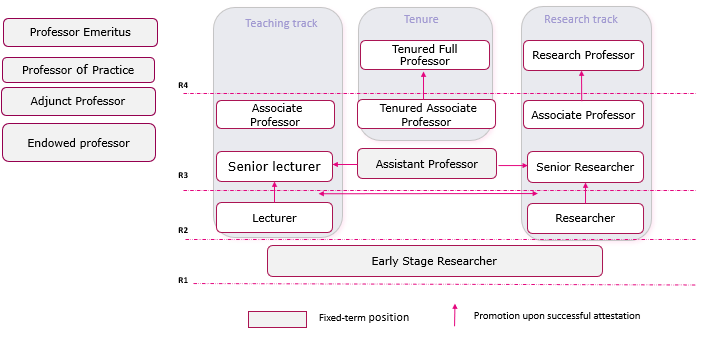
1) Tenured Professor, with the academic ranks of Associate Professor and Full Professor;
2) Research Professor;
3) Associate Professor on the teaching track;
4) Associate Professor on the research track;
5) Assistant Professor;
(2) Lecturer, with the academic ranks of Lecturer and Senior Lecturer;
(3) Researcher, with the academic ranks of Early Stage Researcher, Researcher and Senior Researcher.
(4) The positions of visiting academic staff equivalent to the position of Professor are as follows:
1) Professor Emeritus;
2) Endowed Professor;
3) Adjunct Professor;
4) Professor of Practice.
§ 4. Competencies of academic staff
(1) The competencies of the academic staff are as follows:
1) research competency – the capability to fulfil research tasks and carry out related development activities;
2) teaching competencies – pedagogical, didactic, subject-related, and evaluation competencies;
3) language proficiency in compliance with the university’s language policy;
4) educational technology competency – the ability to apply up-to-date information technology tools in support of teaching and research;
5) other competencies – organisational, managerial, communicative, and social skills.
(2) If a doctoral degree is required for the position, this requirement may, in the creative arts, also be fulfilled by an internationally recognised creative professional who holds at least a master’s degree or an equivalent qualification and has pedagogical skills and experience, including experience in supervising students, as well as at least five years of active creative practice.
§ 5. Main responsibilities of academic staff
(1) The main responsibilities of academic staff are as follows:
1) research and related development activities;
2) teaching and the development of study programmes;
3) professional, vocational activities and public engagement.
(2) Research and related development activities include:
1) fundamental or applied research;
2) publication of the results of research and development;
3) participation in scientific conferences;
4) serving as an expert in the field;
5) supervision of doctoral candidates;
6) performance of applied contracts and provision of consultancy services;
7) entrepreneurial activities related to the university;
8) innovation activities, etc.
(3) Research and related development activities involve:
1) participation in research organisations;
2) applying for and administering funding for research and development activities, etc.;
(4) Teaching includes:
1) face-to-face teaching, including classroom instruction provided by the lecturer (lectures, seminars, practical training, exercises, laboratory work, etc.), work in the e-learning environment, and other forms of teaching;
2) supervision of first- and second-cycle¹ students (consultations, supervision in courses without face-to-face teaching, supervision of projects, etc.);
3) supervision of the graduation theses of first- and second-cycle students;
4) supervision and assessment of internships;
5) provision of feedback on and assessment of students’ learning outcomes (conducting examinations and assessments, reviewing and providing feedback on homework and tests, participation in examination and thesis defence committees, acting as an opponent to and reviewing student papers, etc.).
(5) Study programme development includes:
1) preparation of teaching methodologies;
2) creation of new teaching materials and tools, including materials for e-learning;
3) preparation and updating of study programmes and courses;
4) introducing new teaching methods;
5) participation in the work of committees and working groups involved in the planning and organisation of studies;
6) study programme management, etc.
(6) Professional, vocational activities and public engagement include:
1) popularisation of one’s field of specialisation (profession);
2) participation in the work of professional organisations;
3) development of cooperation with other research and development institutions, companies and organisations;
4) participation in the work of academic bodies, networks, editorial boards and committees outside the university;
5) participation in the work of the councils of the university and its structural units, as well as in other collegial decision-making bodies and committees of the university;
6) preparation and conducting of student admission tests;
7) provision of continuing education, etc.
(7) The head of the structural unit and immediate superior of the academic staff member shall, in agreement with the staff member, set out the staff member’s duties and the distribution of workload between different types of academic activity in the job description, taking into account the nature of the academic position and the structural unit. A greater workload and higher performance in one type of academic activity may compensate for a smaller workload and lower performance in other types of academic activity.
(8) The work output and expected performance indicators of academic staff members are set out in Annex 3, “Academic Evaluation Matrix”, by position and rank.
§ 6. Rights and obligations of academic staff members
(1) An academic staff member has the right to choose teaching methods, research topics and methods in compliance with good academic practice and within the limits of the resources provided by the research funders.
(2) Ordinary members of the academic staff are entitled, within a five-year period, to take one semester leave free of teaching duties in order to pursue professional development or engage in other creative work, while continuing to receive their basic remuneration.
(3) The rights of academic staff members to intellectual property created during their employment at the university shall be laid down by legislation.
(4) An academic staff member is required to:
1) perform the duties agreed upon in the employment contract, job description and this Regulation, comply with the university’s legislation and adhere to the university’s academic practices and the principles of academic ethics;
2) participate in teaching to the extent established for the respective position or as agreed in the job description;
3) ensure that the study materials required for the course taught by the staff member are available to students;
4) ensure that the courses taught by the staff member are up to date;
5) use the university’s assets placed at the staff member’s disposal rationally and sustainably.
(5) Teaching must be conducted at the times set out in the schedule and in the volume specified in the syllabus.
(6) To ensure the quality and coherence of teaching, the responsible lecturer shall agree with the programme director on the organisation of studies (including the content of the course and teaching methods) so that it supports the achievement of the learning outcomes set out in the syllabus.
(7) In matters relating to competition, avoidance of conflicts of interest, and prevention of corruption, academic staff members shall comply with the Work Procedure Rules and other legislation.
§ 7. Description of the position of a Tenured Professor
(1) A Tenured Professor is an internationally recognised scientist or creative professional, an independent researcher, and an academic leader in his/her field who organises and conducts teaching in his/her field of research at all cycles of higher education, leads research, development, or other creative activities, and effectively supervises the students and academic staff involved in these activities. In particular, a Tenured Professor shall be responsible for educating the next generation of academics and providing mentorship, shall actively seek competitive funding, and shall serve as a leading spokesperson in his/her field in Estonia, as well as a coordinator of cross-sectoral cooperation. The ranks of the position of Tenured Professor are Full Professor and Associate Professor.
(2) A Tenured Professor must hold a doctoral degree or an equivalent qualification.
(3) Completion of postdoctoral studies and/or acquisition of professional experience at another organisation outside Tallinn University of Technology, preferably in an international research environment, is considered an advantage for eligibility for the position of Tenured Professor.
(4) The level of scientific publications and the number of citations of a Tenured Professor must be comparable to those of professors in the same field at reference universities. The effectiveness of doctoral studies is a key indicator in the assessment of the effectiveness of the research conducted and organised by the Professor and constitutes a significant component in the evaluation of his/her qualifications.
(5) A Tenured Professor shall take the lead in educational development activities related to his/her field of research and must participate actively in teaching.
(6) The position of Tenured Professor is a full-time permanent position. Part-time employment may be permitted during the transition period upon appointment to the position.
(7) Tenured Professors shall undergo attestation every five years.
(8) A Tenured Professor and his/her immediate superior shall analyse the development of the Professor’s work output and the achievement of the expected performance indicators once a year at an annual appraisal meeting.
(9) The immediate superior of a Tenured Professor is the Head of Department, the Head of a sub-unit or research group appointed by the Head of Department, or the Dean in the case the Professor performs the functions of the Head of Department.
§ 8. Description of the position of a Research Professor
(1) A Research Professor is an internationally recognised scientist or creative professional in his/her field, and an academic leader in his/her field who leads research, development, or other creative activities, and effectively supervises the doctoral candidates and academic staff involved in these activities. A Research Professor shall be responsible for educating the next generation of academics and providing mentorship, shall actively seek competitive funding necessary to support the operation of his/her research group, and shall serve as a leading spokesperson in his/her field in Estonia.
(2) A Research Professor must hold a doctoral degree or an equivalent qualification.
(3) A prerequisite for eligibility for the position of Research Professor is the acquisition of professional experience at another organisation outside Tallinn University of Technology, preferably in an international research environment.
(4) The level of scientific publications and the number of citations must be comparable to those of professors in the same field at reference universities. The effectiveness of doctoral studies is a key indicator in the assessment of the effectiveness of the research conducted and organised by the Professor and constitutes a significant component in the evaluation of his/her qualifications.
(5) Research Professors shall undergo attestation every five years.
(6) A Research Professor and his/her immediate superior shall analyse the development of the Professor’s work output and the achievement of the expected performance indicators once a year at an annual appraisal meeting.
(7) The immediate superior of a Research Professor is the Head of Department, the Head of a sub-unit or research group appointed by the Head of Department, or the Dean in the case the Professor performs the functions of the Head of Department.
§ 9. Description of the position of an Associate Professor
(1) An Associate Professor is a recognised scientist, teaching staff member or creative professional and an academic leader in his/her field who organises and conducts teaching in his/her field of research, conducts research, development, or other creative activities, and supervises the students and doctoral candidates involved in these activities. An Associate Professor shall be responsible for educating the next generation of academics and providing mentorship and shall serve as a spokesperson in his/her field, as well as a coordinator of cross-sectoral cooperation. Associate Professor positions are divided, according to the focus of the academic activities, into Associate Professor positions on the teaching track and Associate Professor positions on the research track.
(2) An Associate Professor must hold a doctoral degree or an equivalent qualification.
(3) An Associate Professor on the teaching track leads teaching and study programme development activities, actively teaches at different cycles of higher education, and actively participates in the supervision of students.
(4) An Associate Professor on the research track leads research and development activities, applies for funding, and actively participates in supervision.
(5) An Associate Professor position is a permanent non-tenured position.
(6) Associate Professors shall undergo attestation every five years.
(7) An Associate Professor and his/her immediate superior shall analyse the development of the Professor’s work output and the achievement of the expected performance indicators once a year at an annual appraisal meeting.
(8) The immediate superior of an Associate Professor is the Head of Department, or, if the Associate Professor performs the functions of the Head of Department, the Dean, or a Head of a sub-unit or research group appointed by the Head of Department.
§ 10. Description of the position of an Assistant Professor
(1) An Assistant Professor is a scientist or creative professional with high potential and an independent researcher who organises and conducts teaching in his/her field of research at different cycles of higher education, leads research, development, or other creative activities, and effectively supervises the students and academic staff involved in these activities. An Assistant Professor shall actively seek competitive funding and shall serve as a leading spokesperson in his/her field in Estonia, as well as a coordinator of cross-sectoral cooperation.
(2) An Assistant Professor must hold a doctoral degree or an equivalent qualification.
(3) A person applying for the position of Assistant Professor must have defended his/her doctoral degree no more than ten years prior to appointment².
(4) A prerequisite for eligibility for the position of Assistant Professor is the completion of postdoctoral studies and/or the acquisition of professional experience at another organisation outside Tallinn University of Technology, preferably in an international research environment.
(5) The level of scientific publications and the number of citations of an Assistant Professor must be comparable to those of professors at the same level in the same field at reference universities.
(6) An Assistant Professor shall take the lead in study programme development activities related to his/her field of research and must be actively involved in teaching.
(7) The position of Assistant Professor is a fixed-term, non-tenured position.
(8) The term of office of an Assistant Professor shall not exceed eight years. If, during his/her term of office, an Assistant Professor has not been appointed to a permanent position of Professor for which he/she has applied, he/she shall, following the second attestation, be transferred to an academic position corresponding to his/her level of competence and performance.
(9) As a rule, the first attestation of an Assistant Professor shall take place five years after assuming the position of Assistant Professor, and the second attestation shall take place no later than during the eighth year in the position.
(10) An Assistant Professor and his/her immediate superior shall analyse the development of the Professor’s work output and the achievement of the expected performance indicators once a year during an annual appraisal meeting.
(11) The immediate superior of an Assistant Professor is the Head of Department or, if the Assistant Professor performs the functions of the Head of Department, the Dean, or a Head of a sub-unit or research group appointed by the Head of Department.
§ 11. Description of the position of a Professor Emeritus
(1) A Professor Emeritus is a retired Professor who, by virtue of his/her previous professional experience, is a recognised scientist or teaching staff member in his/her field, serves as a distinguished spokesperson in his/her area of expertise, and is actively involved in supervision.
(2) A Professor Emeritus position shall be established or extended by the Rector upon the proposal of the Dean and on the recommendation of the Rector’s Office.
(3) The provisions applicable to visiting staff shall also apply to the position of Professor Emeritus.
(4) The Head of Department shall determine and agree with the Professor Emeritus the work output and expected performance indicators for the position.
(5) The immediate superior of a Professor Emeritus is the Head of Department or Head of a sub-unit or research group appointed by the Head of Department.
§ 12. Description of the position of an Endowed Professor
(1) An Endowed Professor is a recognised expert in his/her field with academic experience who serves as a leader and promoter and is responsible for the effective implementation of a research topic or research project funded on a targeted basis by an organisation, foundation, or other entity outside Tallinn University of Technology and who is involved in teaching.
(2) The official title of the holder of the position of Endowed Professor shall be formed by combining the name of the organisation funding the position, the name of the project or research topic, and the title of Professor.
(3) An Endowed Professor must hold a doctoral degree or an equivalent qualification.
(4) The position of Endowed Professor is a fixed-term, non-tenured position.
(5) A position of Endowed Professor shall be established or extended by the Rector upon the proposal of the Dean and on the recommendation of the Rector’s Office and on the basis of a contract entered into with the funding entity.
(6) The work output and expected performance indicators of an Endowed Professor shall be determined based on the objectives of the project.
(7) The provisions applicable to visiting staff shall also apply to the position of Endowed Professor, except where the position is held by a member of the university’s academic staff employed under an indefinite-term employment contract.
(8) The immediate superior of an Endowed Professor is the Head of Department or Head of a sub-unit or research group appointed by the Head of Department.
§ 13. Description of the position of an Adjunct Professor
(1) An Adjunct Professor is an internationally recognised academic, an advocate for and recognised developer of his/her field, who participates in teaching and in the application for and implementation of research projects, contributes to strategic developments in his/her field, promotes internationalisation, and enhances the visibility of Tallinn University of Technology among research universities.
(2) The holder of the position of Adjunct Professor shall comply with the qualification requirements established for a Professor.
(3) The position of Adjunct Professor is a fixed-term, non-tenured position.
(4) A position of Adjunct Professor shall be established or extended by the Rector upon the proposal of the Dean and on the recommendation of the Rector’s Office.
(5) The Head of Department shall determine and agree with the Adjunct Professor the work output and expected performance indicators for the position.
(6) The provisions applicable to visiting staff shall also apply to an Adjunct Professor.
(7) The immediate superior of an Adjunct Professor is the Head of Department or the Head of a sub-unit or research group appointed by the Head of Department.
§ 14. Description of the position of a Professor of Practice
(1) A Professor of Practice is a recognised practitioner in his/her field, a developer and advocate of the field, who participates in teaching and in the application for and implementation of research projects, supports innovation and technology transfer, participates in applied research, contributes to strategic developments in his/her field, promotes internationalisation, and enhances the visibility of Tallinn University of Technology among employers in the field and in society at large.
(2) A Professor of Practice must hold a doctoral degree or an equivalent qualification.
(3) The position of Professor of Practice is a fixed-term, non-tenured position.
(4) A position of Professor of Practice shall be established or extended by the Rector upon the proposal of the Dean and on the recommendation of the Rector’s Office.
(5) The Head of Department shall determine and agree with the Professor of Practice the work output and expected performance indicators for the position.
(6) The provisions applicable to visiting staff shall also apply to a Professor of Practice.
(7) The immediate superior of a Professor of Practice is the Head of Department or the Head of a sub-unit or research group appointed by the Head of Department.
§ 15. Description of the position of a Lecturer
(1) A Lecturer is an academic staff member recognised in his/her field who conducts teaching and supervises students at the university, primarily at the first and second cycles of higher education, but who may also be involved in doctoral studies and who actively participates in the study programme development, whereas:
1) the main responsibilities of a Senior Lecturer are to prepare and deliver lectures, conduct practical training and practical classes, conduct examinations and assessments, and supervise graduation theses;
2) the main responsibilities of a Lecturer are to prepare and deliver lectures, conduct practical training and practical classes, conduct examinations, assessments, and other forms of evaluation, and supervise graduation theses.
(2) Lecturer’s qualifications:
1) a Senior Lecturer must hold a doctoral degree³ or an equivalent qualification;
2) A Lecturer should
a) preferably hold a doctoral degree or an equivalent qualification; or
b) hold a master’s degree or an equivalent qualification supplemented by an occupational qualification certificate at level 8 of the Estonian Qualifications Framework or its international equivalent; or
c) hold a master’s degree4 or an equivalent qualification supplemented by at least five years of professional work experience or teaching experience in the relevant field.
(3) Participation in research:
1) a Senior Lecturer shall participate in research and related development activities to the extent agreed in the job description in order to develop his/her qualifications and acquire competence in the supervision of second-cycle graduation theses.
2) a Lecturer has the right to participate in research and related development activities.
(4) The position of Lecturer is a permanent position.
(5) Lecturers shall undergo attestation every five years.
(6) The immediate superior of a Lecturer is the Head of Department, or, if the Lecturer performs the functions of the Head of Department, the Dean, or a Head of a sub-unit or research group appointed by the Head of Department.
§ 16. Description of the position of a Researcher
(1) A Researcher is an academic staff member who participates in the implementation of a research topic or research project, whereas:
1) a Senior Researcher is a recognised scientist in his/her field who leads a research topic or research project or is responsible for the implementation of essential parts thereof and who is involved in doctoral studies and the supervision of doctoral theses;
2) a Researcher participates in the implementation of a research topic or research project or is involved in servicing specific research infrastructure. The official title of a Researcher holding a postdoctoral position shall be Postdoctoral Researcher;
3) an Early Stage Researcher is an academic staff member enrolled in doctoral studies at the university whose main responsibility is to conduct research related to the topic of his/her doctoral thesis.
(2) Researcher’s qualifications:
1) a Senior Researcher and a Researcher must hold a doctoral degree or an equivalent qualification;
2) an Early Stage Researcher must hold a master’s degree or an equivalent qualification.
(3) A Researcher shall be involved in teaching and in the study programme development.
(4) The positions of Senior Researcher and Researcher may be either fixed-term or permanent, depending on the main functions of the position, the expected work outcomes, and the nature of the funding sources. Permanent Researcher positions shall be established in order to strengthen the research area, develop specialised research expertise, and maintain the related research infrastructure.
(5) A fixed-term position of Early Stage Researcher shall be established for the nominal duration of the doctoral studies.
(6) Researchers shall undergo attestation as follows:
1) Senior Researchers and Researchers employed under an indefinite-term employment contract shall undergo attestation every five years;
2) Early Stage Researchers shall undergo attestation once a year in connection with the attestation of doctoral candidates.
(7) The immediate superior of a Researcher is the Head of Department, or, if the Researcher performs the functions of the Head of Department, the Dean, or a Head of a sub-unit or research group appointed by the Head of Department. The superior of an Early Stage Researcher is the supervisor of his or her doctoral thesis.
(8) The position of Researcher shall be funded primarily from projects or contracts.
Chapter 3
ESTABLISHING AND FILLING ACADEMIC POSITIONS
§ 17. Establishing academic positions
(1) The positions of Tenured Full Professor, Tenured Associate Professor, and Research Professor shall be established by the Senate upon the proposal of the Dean. The Committee for Academic Affairs, the Committee for Research and the Rector’s Office shall assess the need to establish or reorganise the positions of Tenured Professor and Research Professor, as well as the need to abolish established positions that have not been filled. Positions that have been established but not filled may be filled in accordance with the procedure laid down in this Regulation.
(2) The School Council shall establish the positions of Associate Professor and Assistant Professor upon the proposal of the Head of Department.
(3) The Rector shall establish the positions of Professor of Practice, Endowed Professor, Adjunct Professor, and Professor Emeritus upon the proposal of the Dean. The Rector’s Office shall assess the need to establish positions.
(4) The Human Resources Office shall keep records of all Professor positions. The staff register shall specify the title of the position, the main objectives of the position, the job description, the place of the position within the organisational structure, and the details of the position holder.
(5) Other academic positions shall be established by entering into an employment contract.
(6) The main objectives, responsibilities, and expected work outcomes of a position shall be approved as follows:
1) by the Senate upon the proposal of the Dean, when a position of Tenured Professor or Research Professor is established;
2) by the School Council upon the proposal of the Head of Department, when a position of Associate Professor or Assistant Professor is established;
3) by the Dean upon the proposal of the Head of Department, when a position of Professor of Practice, Endowed Professor, Adjunct Professor or Professor Emeritus is established, by approving the employee’s employment contract and job description;
4) by the Head of Department when a position of Lecturer or Researcher is established, by signing the employment contract.
(7) The academic positions provided for in this Regulation, excluding the positions of Tenured Professor, shall be established within an academic structural unit or within an administrative and support unit operating on the basis of a statutes approved by the Rector. In the case of a position established within an administrative or support unit:
1) the responsibilities assigned under this Regulation to the Dean shall be performed by the Vice-Rector for Research, and the responsibilities assigned to the Head of Department shall be performed by the head of the unit;
2) the immediate superior of a person holding a position specified in § 8–16 shall be the head of the unit or a person appointed by the head of the unit.
§ 18. Procedure for filling academic positions
(1) Academic staff shall be:
1) elected to a position through a public competition;
2) hired through targeted recruitment;
3) promoted, as a result of attestation, to the next rank of a Tenured Professor position, transferred between the positions of Associate Professor and Research Professor, or transferred between the positions of Researcher or Lecturer;
4) transferred, as a result of attestation, to a position corresponding to the employee’s qualifications or to an equivalent position on the research or teaching track.
§ 19. Announcement of competitions for filling academic positions
(1) A competition for the positions of Tenured Professor, Research Professor, and Associate Professor shall be announced by the Rector upon the proposal of the Dean; a competition for the position of Assistant Professor shall be announced by the Dean upon the proposal of the Head of Department; and a competition for the positions of Lecturer and Researcher shall be announced by the Head of Department.
(2) A proposal to announce a competition shall be accompanied by:
1) a job description;
2) the proposed date of commencement of employment;
3) the term of appointment in the case of a fixed-term position;
4) the expected annual gross salary range;
5) in the case of Tenured Professor positions, the rank of the position, where its publication in the competition notice is justified.
(3) As a rule, competitions for the positions of Professor shall be announced at least one year before the commencement of employment in the position, and competitions for other academic positions shall be announced at least six months before the commencement of employment in the position.
(4) The competition notice shall be published in public media four to eight weeks before the deadline for the submission of applications. All competition notices for Professor positions shall be published in international media.
(5) In order to participate in the competition, a candidate shall submit the following documents:
1) an application;
2) in the case of first-time applicants to the university, documents certifying that the candidate holds the required academic degree and has acquired the required education;
3) a curriculum vitae and a list of publications (preferably listed and published in ETIS5);
4) an academic portfolio6, in the case of university staff, a reasoned self-evaluation regarding compliance with the requirements for the position set out in Annex 3, “Academic Evaluation Matrix”; or in the case of external applicants, a free-form evaluation of the academic activities undertaken to date and the competencies required for the position;
5) a vision statement or action plan for the following employment period (required only from candidates applying for a Professor position; maximum total length 1,500 words), which, in the case of university employees, shall be included in the academic portfolio;
6) other documents arising from the specific nature of the position, as specified in the terms and conditions of the competition.
(6) Candidates may be required to deliver a public lecture (venia legendi) or a video recording of the venia legendi lecture7 or demonstrate another teaching method reflecting their teaching competencies, provided that equal treatment of all candidates is ensured.
(7) Any technical tasks related to announcing the competition and registering candidates shall be performed by the Human Resources Office, while the event referred to in subsection (6) shall be organised by the department.
§ 20. Organisation of elections
(1) To conduct the regular election of a Professor, the Rector shall, upon the proposal of the Dean, appoint a five-member recruitment committee consisting of the Dean, at least three members of the academic staff, including preferably one international expert familiar with the field, and one representative of the Human Resources Office assisting the committee in its work. The election of other academic staff members shall be organised by the Head of Department.
(2) The recruitment committee shall conduct the election of Professors, targeted recruitment, and the pre-selection of candidates, and shall provide candidates with information and notify them of decisions related to the competition.
(3) Within three working days after the application deadline, the Human Resources Office shall submit the application documents of applicants for Professor positions to the recruitment committee and those of applicants for other academic positions to the Head of Department.
(4) The recruitment committee shall verify the compliance of the application documents of applicants for Professor positions, while the Head of Department shall organise the verification of the application documents of applicants for other academic positions. If it appears during the verification of the application documents that an applicant’s documents are insufficient for assessing compliance with the requirements established for the position, the applicant may be requested to submit additional documents or provide an explanation demonstrating compliance with the requirements. The chair of the recruitment committee may decide not to submit an applicant’s documents to the committee if the applicant’s qualifications do not meet the requirements established for the position or if the submitted documents do not comply with subsection 19 (5).
(5) A member of the recruitment committee, or the Dean or Head of Department organising the election, shall recuse themselves from actions related to the election if an applicant is personally related to him/her or if a risk of a conflict of interest arises that prevents him/her from performing his/her duties impartially. The recruitment committee may request the Rector to appoint alternate members in order to ensure the committee’s operational capacity.
§ 21. Expert assessment in the election of academic staff through public competition
(1) At least two experts whose qualifications meet the qualification requirements established for the position concerned shall assess the eligibility of applicants for academic positions. Experts shall be appointed on the basis of the research field of the position to be filled and in a manner that avoids conflicts of interest. Applicants for the position of Assistant Professor or Associate Professor shall be evaluated by three experts, two of whom must be from outside Estonia. Applicants for the positions of Tenured Professor and Research Professor shall be evaluated by three experts from outside Estonia.
(2) The Rector shall appoint the experts for the evaluation of applicants for the positions of Tenured Professor, Research Professor, and Associate Professor, and the Dean shall appoint the experts for the evaluation of applicants for the position of Assistant Professor. The Rector or Dean shall establish the deadline for the submission of the evaluation results and candidate rankings. The recruitment committee shall, with the approval of the Vice-Rector for Research, make a proposal for the appointment of experts. The recruitment committee shall rank the candidates on the basis of the experts’ evaluations.
(3) The Head of Department shall appoint experts for the evaluation and ranking of candidates for other academic positions and shall establish the deadline for the submission of the evaluation results and candidate rankings.
(4) The deadlines for the submission of evaluation results and rankings shall be established taking into account that the experts must be given at least four weeks and, in the case of the evaluation of candidates for a Professor position, at least eight weeks to prepare their evaluations. The recruitment committee may adjust the deadlines taking into account the circumstances of the competition.
(5) The recruitment committee or the Head of the Department shall forward the documents of eligible candidates, together with student feedback8, to the experts and, where the number of candidates is high, may carry out a pre-selection. Application documents submitted by applicants who do not meet the application requirements shall be returned no later than one month after the application deadline.
(6) Documents related to the competition shall be accessible, on a need-to-know basis, to the recruitment committee, the staff supporting the selection process, and the persons involved in the selection and decision-making process.
§ 22. Elections
(1) Persons filling the positions of Tenured Professor, Associate Professor, and Research Professor shall be elected by the Senate of the university; persons filling the positions of Assistant Professor shall be elected by the School Council; and persons filling the positions of Lecturer and Researcher shall be elected by the Department Council.
(2) At least two weeks before the date of the election, the recruitment committee shall submit to the Senate of the university or the School Council the application documents of candidates for Professor positions, the experts’ evaluations, and the ranking prepared by the recruitment committee on the basis of Annex 3, “Academic Evaluation Matrix”. The Head of Department shall submit to the Department Council the application documents and experts’ evaluations of candidates for other academic positions.
(3) As a rule, elections for Professor positions shall be held six months before the commencement of employment in the position, and elections for other academic positions shall be held two months before the commencement of employment in the position.
(4) The Rector’s Office shall determine the rank of a Tenured Professor on the basis of the recommendation of the recruitment committee before the meeting of the Senate.
(5) The Rector’s Office or the recruitment committee may, for justified reasons, declare the competition for a Professor position unsuccessful.
(6) The elections are held by secret ballot.
(7) The results of the elections shall be approved by the decision-making body that elected the person to the position.
(8) The Head of Department or, where the elected Professor performs the functions of the Head of Department, the Dean, shall negotiate the terms of employment with the person elected to the academic position. The Rector or a person authorised by the Rector shall conclude an employment contract with the person elected to the academic position. A decision not to conclude an employment contract may be made if a violation of this Regulation has occurred or if the parties fail to reach agreement on the terms of employment.
(9) If the university and the elected candidate fail to reach agreement on the terms of employment within a reasonable period following approval of the election results, a new election may be held, without announcing a public competition, among the other candidates ranked by the experts, or the competition may be declared unsuccessful.
§ 23. Filling academic positions through targeted recruitment
(1) The Rector may enter into a fixed-term employment contract with a person who meets the qualification requirements for an academic position if:
1) recruitment to the position through a public competition has failed; or
2) the work to be performed in the position is temporary and fixed-term, or
3) in the case specified in subsection 16 (5).
(2) In justified cases, the Rector may enter into an employment contract for a period of up to six months with a person who meets the qualification requirements for an academic position pending the outcome of the competition, if the work to be performed commences before the position is filled through competition.
(3) The proposal to enter into an employment contract with a person referred to in this section, as well as the proposal to appoint a Professor pursuant to clauses (1) 1) and 2) of this section, shall be made by the Head of Department; the appointment of the Professor shall be approved by the Dean.
(4) In exceptional cases, the Rector has the right, upon the proposal of the Dean and with the consent of the Senate, to enter into an employment contract for the position of Tenured Professor or Research Professor without announcing a competition with internationally recognised top-level researchers whose research and development performance exceeds the requirements established in the Academic Evaluation Matrix several-fold.
§ 24. Promotion to the next rank of an academic position
(1) If the holder of a position complies with the requirements established for the position and has undergone attestation in accordance with the procedure established at the university, the Rector may, without announcing a public competition, promote the holder of the position as follows:
1) from Lecturer to Senior Lecturer;
2) from Researcher to Senior Researcher;
3) from Lecturer or Senior Lecturer to Researcher or Senior Researcher;
4) from Researcher or Senior Researcher to Lecturer or Senior Lecturer;
5) from Tenured Associate Professor to Tenured Full Professor;
6) from Associate Professor on the research track to Research Professor.
(2) The proposal to promote a Tenured Associate Professor to Tenured Full Professor and an Associate Professor to Research Professor shall be submitted to the Rector by the Dean on the basis of the decision of the attestation committee; in the case of other positions, the proposal shall be submitted by the Head of Department.
Chapter 4
PERFORMANCE EVALUATION AND FEEDBACK
§ 25. The purpose of performance evaluation
(1) The purpose of the performance evaluation of academic staff members is to assess the compliance of their work results with the established requirements, provide feedback, and encourage them to improve the university’s academic performance. Performance evaluation shall support the career development and professional development of academic staff members.
(2) The performance of academic staff members shall be evaluated and feedback provided:
1) in the course of an annual appraisal meeting;
2) upon attestation.
§ 26. Annual appraisal meeting and job description
(1) In order to assess the work performance of an academic staff member and plan his/her future development, the immediate superior shall conduct an annual appraisal meeting with the staff member at least once a year. If necessary, the superior conducting the annual appraisal meeting may request the opinion of experts in the relevant field in order to assess the employee’s previous work performance.
(2) The distribution of an academic staff member’s workload between the main responsibilities of academic staff and the expected performance indicators shall be agreed between the staff member and his/her superior in the job description, which shall be attached to the employment contract.
(3) The job description shall serve as the basis for the attestation of the staff member by defining the focus of the staff member’s academic activities and, where necessary, any agreed deviations from the requirements established for the position.
§ 27. Attestation
(1) “Attestation” means the regular evaluation of the competencies and work performance of academic staff members and of the achievement of the expected performance indicators, the purpose of which is to assess and ensure:
1) the suitability of the employee for continuing in the position held by the employee;
2) the suitability of an employee holding a fixed-term position (except Early Stage Researchers and Assistant Professors) for transfer to the corresponding indefinite-term position;
3) the suitability of the employee for promotion to positions permitted under this Regulation.
(2) Academic staff members shall undergo attestation at least once every five years during their employment. In justified cases and with the Dean’s consent, the Head of the Department may require an employee to undergo attestation before the expiry of the prescribed interval.
(3) A person elected as a Professor for the first time, or a Professor commencing employment at the university for the first time, shall undergo first attestation within one to three years of assuming the position of Professor, based on the performance agreement set out in the job description and the Evaluation Matrix. The first attestation period for an Assistant Professor shall be up to five years.
(4) The date of attestation shall be calculated from the date on which the employee commenced employment in the respective position or was promoted to the next academic rank.
(5) For the purposes of this Regulation, election or appointment to a fixed-term academic position, or the conclusion of a fixed-term employment contract for such a position, shall be deemed equivalent to attestation.
(6) The Human Resources Office shall submit, no later than 1 December of each year, to the Rector or the Dean, respectively, a list of employees subject to regular attestation in the following year.
(7) If, during the attestation period, an employee was on parental, maternity or paternity leave, or in compulsory military or alternative service, the period for compliance with the requirements and for attestation shall be extended at the employee’s request by the duration of such leave or service. By agreement, the attestation period may be extended by the duration of a long-term suspension of the employment contract (for example, in the case of intersectoral mobility) or unpaid leave, but by no more than one nominal attestation period.
(8) If an employee has performed the functions of the head of an academic unit during the attestation period, the period for compliance with the requirements and the attestation period may be extended by up to one nominal attestation period. The extension of the attestation period shall be approved by the Rector upon the proposal of the Dean.
§ 28. Conducting attestation
(1) Attestation, with the exception of the attestation of a Professor, shall be conducted by a committee established by the Dean and consisting of at least three members, including the Head of the Department in which the employee is employed. The chair of the committee shall be appointed by the Dean.
(2) Attestation of a Professor shall be conducted by a committee established by the Rector and consisting of at least three members, including the Head of the Department in which the person being attested is employed. The Dean shall participate in the work of the committee without voting rights. The Rector may appoint external experts to the committee. The chair of the committee shall be appointed by the Rector.
(3) The Human Resources Office shall prepare a proposal for the attestation schedule.
(4) The members of an attestation committee must meet the qualification requirements applicable to the position being evaluated.
(5) The Human Resources Office shall, no later than two months before the meeting of the attestation committee, notify the employee and the Head of the Department of the planned attestation schedule, the deadline for submission of the required documents, and the procedure for communicating the decision.
(6) The attestation committee shall assess the employee’s work performance and compliance with the professional requirements of the position on the basis of the relevant description of the position set out in this Regulation, the curriculum vitae published in the Estonian Research Information System (ETIS), the individual job description, the work results achieved, the expected performance indicators set out in the academic evaluation matrix, and the following documents submitted by the employee:
1) an academic portfolio (incl. a reasoned self-assessment of work performance based on the academic evaluation matrix; in the case of a Professor, the objectives for the following five years and an action plan for achieving those objectives, with a maximum total length of 1,500 words, and the action plan prepared for the previous attestation or for applying for the position;
2) any other materials deemed necessary by the employee or the attestation committee.
(7) If an employee fails, without good reason, to submit the required documents by the deadline set by the attestation committee, the attestation committee has the right to assess the employee and the employee’s work results as not meeting the requirements for the position.
(8) An employee shall have the right to access the documents used in his/her attestation and to present his/her work performance at the meeting of the attestation committee before the decision is made.
(9) The attestation committee shall provide a reasoned assessment of the employee’s work performance and compliance with the professional requirements of the position and, based on the objectives of attestation specified in clauses 27 (1) 1) and 3) of the Regulation, and shall adopt one of the following decisions:
1) the employee and the employee’s work performance meet the requirements for the position;
2) the employee and the employee’s work performance do not meet the requirements for the position;
3) the attestation committee recommends promotion;
4) the attestation committee does not recommend promotion;
5) the attestation committee recommends transferring the employee to a position for which the employee qualifies (except for the position of Professor) or granting the employee emeritus status;
6) the attestation committee recommends transferring an employee employed as a Lecturer or Researcher under a fixed-term employment contract to the same position under an indefinite-term employment contract.
(10) The attestation committee may provide the employee with recommendations for improving work performance and supporting professional development.
(11) The assessment, decision, and recommendations of the attestation committee shall be recorded in written minutes within two weeks, and the minutes shall be signed by the chair of the committee. The Head of the Department shall notify the employee of the decision and recommendations of the attestation committee, first as preliminary feedback as soon as possible after the committee meeting and subsequently as official confirmation after the minutes recording the committee’s decision have been signed. An employee has the right to request a written summary of the attestation results. The head of the structural unit shall prepare the summary, which shall be approved by the chair of the committee and submitted to the employee and the Human Resources Office for storage. Documentation related to attestation shall be stored by the Human Resources Office.
(12) If the employee or the employee’s work performance does not meet the requirements for the position, the Head of the Department:
1) shall agree with the employee on measures for bringing the employee’s work performance into compliance with the professional requirements, determine the date of re-attestation taking into account the reasonable time required for improvement of work performance, and notify the employee and the Human Resources Office thereof;
2) may initiate the transfer of the employee to the position recommended by the attestation committee. No competition procedure is required for such transfer;
3) has the right to initiate extraordinary termination of the employment contract in accordance with the Employment Contracts Act and notify the employee and the Human Resources Office thereof.
§ 29. Disputing the attestation results
(1) An employee has the right to appeal against the decision of the attestation committee within two weeks of being notified of the decision. A Professor shall file an appeal with the Rector, while other employees shall file an appeal with the Dean, stating the reasons for disagreeing with the decision and, where necessary, submitting additional documents.
(2) The Rector or the Dean shall decide on the appeal within one month of receipt thereof.
(3) If, upon review of the case, it is established that a breach of the attestation procedure occurred but could not have affected the attestation decision, the decision shall remain valid.
(4) If, upon review of the case, it is established that a breach of the attestation procedure occurred and affected the attestation decision, the Rector shall determine the date of re-attestation.
§ 30. Implementation of the Regulation
(1) Associate Professors appointed under the previous Regulation on Academic Career Management to the position of Senior Lecturer may continue to use the title of Associate Professor until 31 December 2027. The use of the title of Associate Professor shall be agreed in the employment contract.
(2) A person employed in the position of Leading Researcher on 1 September 2026 may be appointed to the position of Research Professor upon the proposal of the Head of Department if the attestation committee has made a corresponding recommendation.
(3) A person employed in the position of Leading Researcher on 1 September 2026 may be appointed to the position of Professor Emeritus upon the proposal of the Head of Department if the person has been granted emeritus status.
(4) If a person employed in the position of Leading Researcher on 1 September 2026 is granted emeritus status during the transitional period, the indefinite-term employment contract with that person shall be terminated and a new employment contract complying with this Regulation shall be concluded for the position of Professor Emeritus upon the proposal of the Head of Department.
(5) If a person holding the position of Leading Researcher does not continue as a Research Professor or Professor Emeritus during the transitional period, the Head of Department shall, taking into account the recommendation of the attestation committee, agree with the employee on the employee’s transfer to another position corresponding to the employee’s qualifications and not constituting a Professor position.
(6) The transitional period for holders of Leading Researcher positions for transfer to the new positions shall end on 31 August 2028.
The Annexes to the Regulation are:
Annex 1– Hierarchy of Academic Positions;
Annex 2 – Structure of the Academic Portfolio;
Annex 3 – Academic Evaluation Matrix.
§ 31. Repeal of a Regulation
(1) Regulation No 3 of the Senate of Tallinn University of Technology of 18 May 2021 “Academic Career Management” is repealed.
§ 32. Entry into force of the Regulation
(1) The Regulation shall enter into force on 1 September 2026
————————————–
1 The cycles of higher education are as follows: first cycle – professional higher education and bachelor’s studies; second cycle – master’s studies and integrated bachelor’s and master’s programmes in engineering; third cycle – doctoral studies.
2 If, after obtaining a doctoral degree, the employee has taken parental leave, maternity leave, paternity leave, compulsory military service, or alternative service, the eligibility period for appointment to the position of Assistant Professor shall be extended by the corresponding period.
3 For a Senior Lecturer conducting studies in study programmes governed by the Maritime Safety Act, a master’s degree and a certificate of competency as a Captain or Senior Engineer qualified to work without limitations on ship power shall be deemed equivalent to a doctoral degree.
4 For a Lecturer conducting studies in study programmes governed by the Maritime Safety Act, higher education and a certificate of competency as a Captain, Senior Engineer, Electro-Technical Engineer, or Refrigeration Engineer shall be deemed equivalent to a master’s degree. If the condition is met, the official title of the employee shall be Teacher until the master’s degree has been obtained.
5 Estonian Research Information System
6 See Annex 2 to the Regulation
7 The duration of the lecture shall be between 10 and 45 minutes.
8 In case of a candidate who has conducted studies at Tallinn University of Technology
Annex 1
to Regulation No 3 of 19 May 2026 of the of Tallinn University of Technology
Hierarchy of Academic Positions
Annex 2
to Regulation No 3 of 19 May 2026 of the of Tallinn University of Technology
Structure of the Academic Portfolio
An academic portfolio is a source document used for assessing the work performance of an academic staff member of Tallinn University of Technology and the staff member’s compliance with the professional requirements for the position. The portfolio contains qualitative and quantitative information on the employee’s academic activities and provides the employee with an opportunity to present his/her competencies when applying for a position or undergoing attestation.
The structure of the portfolio shall be based on the main responsibilities of academic staff set out in the Regulation on the Academic Career Management and/or the employee’s individual job description.
A portfolio shall consist of three parts and appendices, which may be submitted either as attached documents or as active hyperlinks to documents or electronic environments. Publicly available information shall not be included in the appendices. As a rule, the portfolio shall be 4–6 pages in length, excluding appendices.
Parts of a portfolio:
1. Self-introduction
This section shall include a free-form overview of the employee’s professional experience, relevant career development over recent years, impact on society, principles of academic activity, and any other aspects considered relevant by the employee. For application and attestation, the curriculum vitae published in the Estonian Research Information System (ETIS) is used and need not be included in the portfolio.
2. Reasoned evaluation of competencies and performance indicators set out in the Academic Evaluation Matrix
The level shall be selected in accordance with the requirements established for the employee’s current position or for the position applied for.
In addition, the employee may describe activities and professional engagements outside the university if these have had an impact on the employee’s academic performance.
| Position: | |||
| Type of activity | Level corresponding to the position in the Academic Evaluation Matrix | Level determined based on the employee’s self-evaluation | Explanation of the evaluation result |
| Research and development | |||
| Activity and success in securing funding | |||
| Supervision | |||
| Teaching and study programme development | |||
| Professional and public engagement activities | |||
3. Objectives for the next five years and an action plan for achieving them and the action plan prepared for the previous attestation or for applying for the position
Submission of an action plan is mandatory for persons holding the position of Professor. The maximum length of the action plan shall be 1,500 words.
Annex 3
to Regulation No 3 of 19 May 2026 of the of Tallinn University of Technology
Academic Evaluation Matrix
Use of the Academic Evaluation Matrix
(1) The Academic Evaluation Matrix (hereinafter referred to as the “Matrix”) (Table 1 of Annex 3) is a tool for assessing academic competencies and performance. The matrix shall be used in making decisions concerning appointments to academic positions. The matrix describes levels of academic competencies and performance (hereinafter also referred to as “levels”) on a five-level scale.
(2) The academic positions and the corresponding levels of academic activity (Table 2 of Annex 3) reflect the university’s general requirements for the respective positions.
(3) In the selection and attestation of employees, the numerical indicators set out in the matrix shall be interpreted taking into account the average level in the relevant academic discipline and the specific characteristics of teaching in the respective field of research. As a rule, this assessment shall be based on comparison with Aalto University, Chalmers University of Technology, KTH Royal Institute of Technology, and the universities belonging to the EuroTech Universities Alliance.
(4) An employee shall be expected to meet the threshold requirements for the academic position upon commencement of employment in that position. The recruitment committee may take into account the specific circumstances of candidates whose previous academic career has been pursued outside the university. For example, a strong candidate may have been unable to meet certain appointment threshold requirements in some areas of academic activity set out in the Academic Evaluation Matrix due to the particular nature of his/her previous academic career (for example, where the candidate’s previous institution did not provide doctoral studies). In such cases, the recruitment committee may refer the candidate who does not fully meet the threshold requirements for expert evaluation. Minutes shall be taken of the committee’s decisions.
(5) When evaluating performance during the evaluation period, the requirements established for different types of academic activity shall be assessed as a whole, taking into account the specific characteristics of the discipline and the performance indicators agreed with the employee in the job description for the evaluation period (Reference: subsection 5 (7) of the Regulation on Academic Career Management “The head of the structural unit and immediate superior of the academic staff member shall, in agreement with the staff member, set out the staff member’s duties and the distribution of workload between different types of academic activity in the job description, taking into account the nature of the academic position and the structural unit. A greater workload and higher performance in one type of academic activity may compensate for a smaller workload and lower performance in other types of academic activity.” ). For Professor positions, the requirement to supervise doctoral candidates may not be waived on a discretionary basis. Teaching and supervision workload shall be calculated in accordance with Annex 3 to the Work Procedure Rules, “Estimated Workload and Classroom Contact Hours of Academic Staff”.
(6) If there are not enough students requiring supervision in the study programmes of the relevant field at TalTech or at the employee’s or candidate’s previous institution to meet the supervision requirements, the employee/candidate may demonstrate fulfilment of the supervision requirement through sustained involvement in alternative supervisory activities, such as preparing, conducting and assessing final examinations, supervising internships, or providing other forms of student supervision.
(7) In addition to scientific publications, research outputs may also include objects of industrial property rights and reports prepared under commercial contracts where the contractual terms do not permit publication of the results. To be taken into account, the person undergoing attestation shall submit to the attestation committee evidence of the scope and results of the work performed (e.g. a granted patent, in the case of a commercial contract the volume of the contract, a reference to the publication restriction, and the record of delivery and acceptance).
(8) The performance requirements for the evaluation period are based a five-year period of full-time employment subject to attestation. If a shorter attestation period has been established for the employee’s position or the employee has worked part-time, compliance with the requirements shall be assessed proportionally.
(9) In determining the level required of a candidate for a specific position or of a person holding that position, account shall be taken of the general descriptions of the positions set out in §§ 7–16 of the Regulation on Academic Career Management, as well as the objectives and expected work results specified in the job description for the respective academic position and in the individual job description of the academic staff member.
(10) Recruitment and attestation committees have the right to involve additional experts in the assessment of a candidate’s or employee’s performance.